
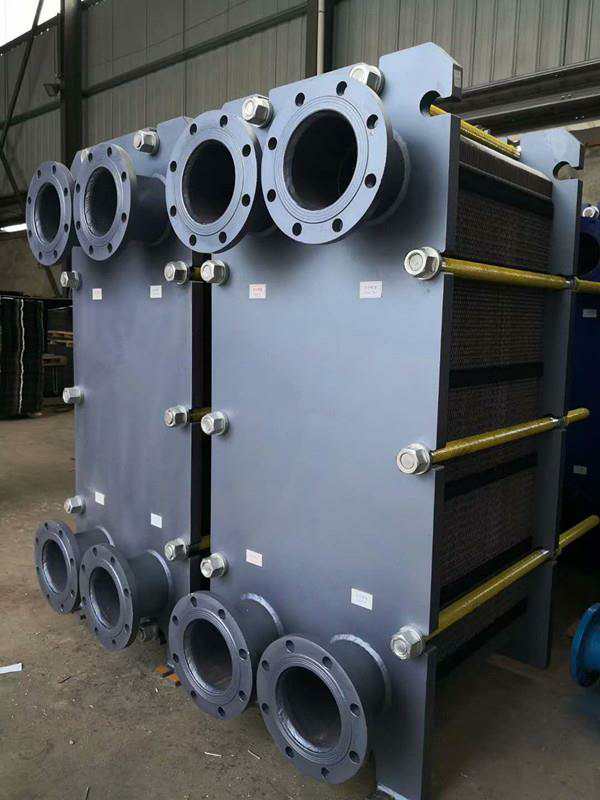
Product Overview
The Plate Heat Exchanger is a highly efficient and compact heat exchange device that achieves heat transfer between two media through channels formed by corrugated plates. The equipment uses high-quality stainless steel or titanium alloy plates, featuring high heat transfer coefficient, small footprint, light weight, and easy disassembly and cleaning. It is widely used in heating, refrigeration, chemical, food, and pharmaceutical industries.
Working Principle
The Plate Heat Exchanger consists of alternating corrugated plates that form narrow channels between adjacent plates. Two fluids (hot and cold) flow on opposite sides of the same plate, transferring heat through the metal plate. The corrugated plate design creates turbulence at low flow rates, significantly improving heat transfer efficiency while reducing the risk of fouling.
Technical Features
- Heat transfer coefficient up to 3000-7000 W/(m²·K), 3-5 times that of shell-and-tube heat exchangers
- Compact structure, footprint only 1/5-1/3 of shell-and-tube heat exchangers
- Plates formed by stamping, uniform channels, balanced pressure distribution
- Flexible adjustment of heat exchange area by adding or removing plates
- Easy disassembly and cleaning, low maintenance cost
- Low metal consumption, excellent cost-performance ratio
Applications
The Plate Heat Exchanger is suitable for various industrial and civil applications:
- Heat exchange stations in central heating systems
- Evaporators and condensers in air conditioning systems
- Heating, cooling, and condensation processes in chemical industry
- Sterilization and temperature control in food and beverage industry
- Waste heat recovery in metallurgy and power industries
- Cooling systems for ships and offshore platforms
Selection Guide
When selecting the Plate Heat Exchanger, consider the following factors: heat transfer medium properties (corrosiveness, viscosity, cleanliness), operating temperature and pressure range, flow requirements, and installation space limitations. It is recommended to choose appropriate plate material (316L stainless steel, titanium, Hastelloy) and gasket material (NBR, EPDM, FKM) based on actual working conditions.
Related Products
Explore more Plate Heat Exchanger series products: